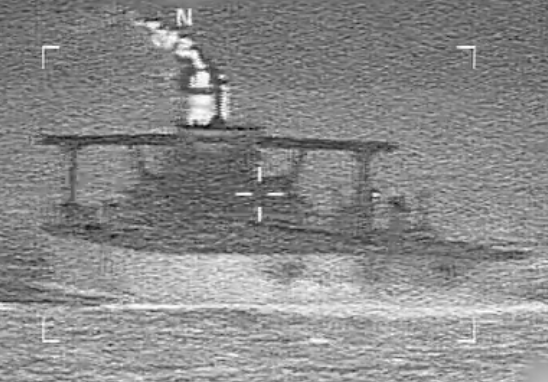
We reported on the interdiction off the UK here, but this also happened today!
Today (January 7, 2026), U.S. forces (primarily the Coast Guard, supported by the military) conducted two coordinated pre-dawn interdictions of sanctioned “dark fleet” oil tankers linked to illicit Venezuelan oil trade:
- The Russian-flagged tanker Marinera (formerly Bella 1) in the North Atlantic, after a weeks-long pursuit involving evasion attempts and a recent re-flagging to Russia. The operation involved helicopters and boarding teams, with British cooperation for surveillance and basing.
- The stateless tanker M/T Sophia in international waters near the Caribbean.
These actions are part of ongoing U.S. sanctions enforcement and the blockade on Venezuelan oil exports, described by officials as occurring “back-to-back” today.
In a pre-dawn action this morning, the Department of War, in coordination with the Department of Homeland Security, apprehended a stateless, sanctioned dark fleet motor tanker without incident.
— U.S. Southern Command (@Southcom) January 7, 2026
The interdicted vessel, M/T Sophia, was operating in international waters and… pic.twitter.com/JQm9gHprPk
U.S. forces conducted a pre-dawn interdiction of the motor tanker M/T Sophia (IMO 9289477) in international waters near the Caribbean Sea, marking the second such operation that day as part of intensified enforcement of sanctions against Venezuela’s illicit oil trade.
Described by U.S. Southern Command as a “stateless, sanctioned dark fleet motor tanker,” the Sophia had been placed under U.S. Treasury sanctions in January 2025 for its prior involvement in transporting Russian oil, evading price caps and restrictions. Intelligence indicated it recently loaded Venezuelan crude—likely around 1-2 million barrels of Merey heavy oil—and departed Venezuelan waters in early January, operating in “dark mode” with its AIS transponder disabled to avoid detection. It was part of a small flotilla attempting to breach a U.S.-imposed maritime blockade following the capture of Venezuelan President Nicolás Maduro days earlier.
The operation, coordinated between the Department of War and the Department of Homeland Security, involved U.S. Coast Guard boarding teams. Helicopters lowered personnel onto the deck in a swift, non-violent apprehension, with no incidents reported. Video released by SOUTHCOM showed the nighttime approach and securement of the vessel. Unlike the simultaneous high-profile pursuit and seizure of the Russian-flagged Marinera in the North Atlantic, the Sophia interdiction was described as routine and uncontested.
The U.S. Coast Guard immediately took control, escorting the tanker to a U.S. port for “final disposition,” which could include cargo offloading, vessel forfeiture, or crew prosecution under sanctions violations. Homeland Security Secretary Kristi Noem highlighted the “back-to-back meticulously coordinated” boardings as evidence of effective deterrence against shadow fleets used by sanctioned nations like Venezuela, Russia, and Iran.
This action underscores the Trump administration’s aggressive posture to control Venezuelan oil flows, aiming to redirect revenues through U.S.-approved channels while crippling evasion networks. No international protests specific to the Sophia were reported, though broader criticisms of U.S. actions targeted the parallel Marinera seizure.